

Sorting through a family home tends to raise way more questions than it settles. That dresser sitting in the hallway? Could be a mass-produced piece some department store churned out, or it could just as easily be a hand-built antique worth several hundred dollars. A ring tucked in a jewelry box might be nothing more than costume jewelry, or it might carry real gold content. Nobody wants to hand over a genuinely valuable piece for pennies, and nobody wants furniture sitting unsold for three weekends straight because it got tagged like a family heirloom.
Learning how to appraise estate sale items really starts in one place: figuring out what you’re actually holding, being honest about its condition, and digging into what similar pieces have genuinely sold for — not what a hopeful seller wishes they’d get. This guide moves through that whole process step by step: identification, doing the research online, working out pricing logic for furniture and household goods, knowing when it’s time to bring in a professional, how your location can shift things, and the mistakes that quietly drain money out of nearly every estate sale.
How to Appraise Estate Sale Items: What the Process Actually Means
Appraising an estate sale item means estimating what it’s realistically worth right now, based on evidence rather than assumption. That evidence includes the item’s maker or brand, its physical condition, how rare or in demand it currently is, and what comparable pieces have actually sold for recently.
It helps to separate a few terms that get used interchangeably but mean different things:
- Fair market value. What a willing buyer would pay a willing seller, neither one under pressure to act.
- Estimated value. A working number based on research, before any formal appraisal.
- Estate sale asking price. The tag price, which often sits below full market value because the goal is to sell within a weekend.
- Final selling price. What the item actually sells for after negotiation.
- Formal appraisal. A documented valuation from a credentialed appraiser, usually needed for insurance, tax, or legal purposes.
Depending on the situation, you may actually be thinking about resale value, liquidation value, or fair market value, and those numbers don’t always match. A lamp might have an estimated value of $60 based on similar sold listings, get tagged at $35 for the sale, and end up selling for $25 after a buyer negotiates. None of those numbers are wrong. They’re just answering different questions.
How to Appraise Estate Sale Items Step by Step
This is the part most people skip, and it’s the part that actually determines whether pricing ends up close to reality or way off in either direction.
Make an Inventory
Before pricing anything, write it down. For each item, record a short description, the manufacturer or maker if known, dimensions, materials, approximate age, visible condition issues, and quantity if there are multiples. This sounds tedious for a houseful of belongings, but it’s the only way to avoid mixing a genuinely valuable serving set in with a box of mismatched mugs.
Identify the Maker, Brand or Artist
Flip furniture over. Check the underside of ceramics. Look inside jewelry clasps. Manufacturers often leave marks in places nobody thinks to look, such as a stamped signature under a drawer or a foundry mark on a bronze piece. Labels, model numbers, and serial numbers all narrow down exactly what you’re holding, and identification is usually the single biggest factor in whether an item is worth $10 or $500.
Check Condition Honestly
Condition can matter more than age. A worn, water-stained bookcase from a well-known maker may be worth less than a plain but pristine one. Note cracks, missing hardware, stains, replaced parts, and any prior restoration. Restoration isn’t automatically bad. It can preserve value on some antiques and reduce it on others, depending on the category and how the repair was done.
Research Comparable Sales
This is where most self-appraisals go wrong. People search a marketplace, find an active listing asking $400 for something similar, and assume that’s the value. Active asking prices prove almost nothing, since anyone can list an item at any price. What matters is what similar items have actually sold for.
On eBay’s completed and sold listings, you can narrow things down to only the items that actually sold, which paints a far more honest picture than scrolling through whatever’s currently listed. Results from auction houses, particularly specialist ones dealing in fine art or coins, are another dependable source, since those figures come from real transactions with real bidders competing for the piece.
Check Rarity and Demand
Being old doesn’t automatically translate into being valuable. Plenty of genuine antique furniture goes for modest prices simply because it was mass-produced and there’s a lot of it floating around. On the flip side, a mid-century piece from a maker who’s currently trendy can fetch a surprising premium purely because collector interest has shifted that way. Rarity and demand move on their own timeline, separate from age, and honestly, both carry more weight than how many decades something has existed.
Consider Provenance and Authenticity
When it comes to fine art, signed work, and higher-end antiques, provenance — basically the paper trail of who owned something and where it’s been — can shift the value considerably. A painting backed by clear ownership records and gallery documentation sits in a completely different category than an unsigned piece with no history to point to. Authenticity isn’t something you want to guess at. If real doubt creeps in, that’s your cue to get a second opinion rather than assuming things will land on the best or worst possible outcome.
Estimate a Realistic Value Range
Once identification, condition, comparable sold prices, and rarity and demand are all accounted for, you land on a value range rather than one rigid number. Something like $80 to $120 is more honest than a single figure, simply because market value shifts depending on who happens to be shopping that particular week.
How to Appraise Estate Sale Items Online
Appraising items online works reasonably well for identification and getting a market read, though it has real limits. A practical process looks like this:
- Photograph the item clearly, from multiple angles.
- Photograph any labels, signatures, stamps, or markings up close.
- Measure it, since dimensions matter for furniture especially.
- Search the exact maker, brand, or model number.
- Filter for sold or completed listings, not active ones.
- Compare at least three or four similar examples, not just one.
- Compare condition against your own item honestly.
- Check recent auction results if the category has active auction houses.
- Decide whether the online picture is confident enough to price from, or whether it raises questions.
The limitation worth being upfront about: a photograph can help identify what something is, but it usually can’t confirm authenticity, detect hidden damage, verify materials like solid gold versus plating, or establish provenance. Online research narrows things down. It doesn’t replace physical inspection for anything where the stakes are high enough to matter.
How Much Are Estate Sale Items Worth?
There’s no universal formula here, and any guide that gives you one flat percentage of “original value” is oversimplifying. What actually drives value:
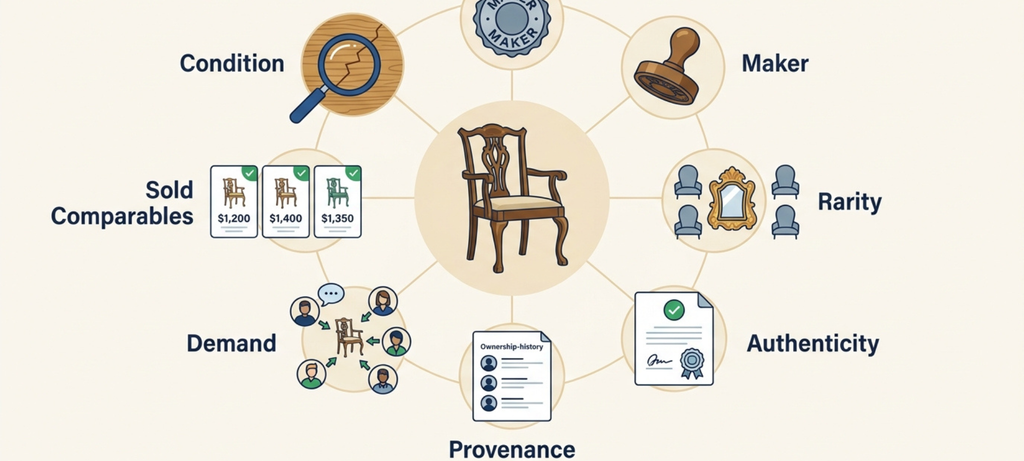
- Condition
- Maker or brand reputation
- Rarity
- Authenticity
- Provenance
- Current collector or buyer demand
- Geographic market, since some regions have stronger demand for specific categories
- What comparable items have actually sold for
- The selling method itself, whether that’s auction, estate sale, or private sale
Two nearly identical dressers can sell for very different amounts depending on which city they’re in and who happens to be shopping that weekend. That’s frustrating if you want a clean answer, but it’s also just how secondhand markets work.
How Does Estate Sale Pricing Work?
Estate sale pricing usually sits below full market value on purpose, because the goal is a fast sale within a short, fixed window rather than the highest possible price over time. Estimated market value and estate sale pricing aren’t the same conversation. The general sequence looks like research value, set an asking price, watch how buyers actually respond, adjust or negotiate, and arrive at a final selling price, often with markdowns applied on the last day of the sale.

Estate sale pricing tends to sit below broader market value for a few practical reasons. The sale runs for a fixed, short window, usually a weekend or two. Buyers are local and browsing in person, which limits the pool compared to a national online marketplace. There’s an expectation of negotiation built into the format. And sellers usually want the house cleared, not the absolute maximum dollar for every item, since urgency changes the math.
A large antique dining table is a good example. It might carry solid market value based on maker and condition, but at an estate sale it may need a lower price than that value suggests, simply because fewer buyers show up with a truck and the space to fit an eight seat table into their home that same afternoon. Size and logistics affect what a piece sells for even when they don’t change what it’s technically worth.
How to Price Estate Sale Items
Start with a researched market value range, then adjust the price for condition, local demand, sale timing, buyer expectations, and how quickly the item needs to move. There isn’t one pricing formula that works across furniture, jewelry, electronics, and kitchenware, since each category responds to different signals. A reasonable general approach: start from your researched value range, adjust downward based on how quickly the item needs to sell, adjust further based on how much competing inventory is in the sale, and leave a little room for negotiation, since most estate sale buyers expect to haggle at least a bit.
Items in high demand with limited supply can be priced closer to the top of the researched range. Common household items with plenty of comparable inventory available everywhere should generally be priced toward the lower end, since buyers have easy alternatives.
How to Price Household Items for an Estate Sale
Everyday household goods don’t need the same depth of research as antiques or jewelry, but they still benefit from a quick check against condition, completeness, and brand.
| Category | What to Check |
|---|---|
| Furniture | Material, brand, condition, size |
| Electronics | Model, age, working condition |
| Kitchenware | Brand, pattern, completeness |
| Tools | Brand, model, condition |
| Books | Edition, rarity, condition |
| Décor | Maker, age, style, condition |
Completeness matters more than people expect. A set of dishes missing three pieces sells for noticeably less than a complete set, even if each individual plate is otherwise identical.
Pricing Furniture for an Estate Sale
Furniture pricing hinges on a few specific questions: Is it solid wood or manufactured veneer? Is it actually antique, or just old? Does it carry a recognizable or designer brand? What condition is it in, and has it been restored?
Size ends up mattering just as much as craftsmanship. A gorgeously made piece that’s oversized can actually be tougher to sell than a smaller item of comparable quality, purely because fewer buyers have the space or the means to haul it away. Take a solid wood mid-century sideboard from a recognizable maker — it might carry real underlying value, but pricing it sensibly for a weekend estate sale means facing a simple reality: most people walking through already have a specific spot in mind, and they won’t buy something that doesn’t fit there no matter how attractive the price tag looks. Knowing what separates ordinary furniture from genuine luxury furniture helps here too, since that gap often explains why two pieces that look nearly identical end up priced so differently.
How to Appraise Antiques, Jewelry, Furniture and Collectibles
Each category calls for its own kind of digging. With antique furniture, it’s mostly about maker, wood type, joinery, and condition. Jewelry comes down to metal content, gemstone quality, hallmarks, and craftsmanship — and whether a karat stamp exists at all can flip the whole valuation. The same attention people put into picking jewellery for meaningful occasions is worth flipping around when appraising it later, since materials and craftsmanship reveal just as much about value as they once did about sentiment. Watches hinge on brand, movement type, whether they still run, and whether original paperwork survived. Coins come down to mint marks, condition grading, and how rare a piece is within its series. Fine art rests on artist, medium, provenance, and the physical condition of the canvas or paper itself. Sterling silver is about hallmarks and weight. Books depend on edition, print run, and the dust jacket’s condition just as much as the actual pages inside.
The common thread: identification comes first, in every single category, before any value estimate means anything.
When Should You Hire a Professional Appraiser?
Self-research covers most household items well. It stops being enough in a handful of situations: fine art, expensive jewelry, rare antiques, meaningful collections, historically unusual objects, or anything where authenticity is genuinely in question. It’s also worth involving a professional when the valuation needs to hold up for tax purposes, insurance coverage, or legal and estate administration requirements. Those are situations where an informal estimate simply won’t satisfy the paperwork.
The American Society of Appraisers maintains a directory of credentialed appraisers across specialties, which is a reasonable starting point if a formal, documented valuation is what the situation calls for. A formal appraisal is a different product entirely from an online estimate or a casual resale opinion. It’s a documented, defensible valuation prepared for a specific purpose, and it typically costs money accordingly. Most items in a household clearance don’t need one. The handful that might be worth real money often do.
How to Appraise Estate Sale Items in California, Kansas and Florida
The underlying appraisal process (identify, inspect, research, compare, estimate) doesn’t change from state to state. What can differ locally are market conditions, the density of buyers for certain categories, and, in some cases, state specific rules around estate administration, tax reporting, or licensing requirements for professionals conducting formal appraisals.
Local demand can vary considerably within California, Kansas, and Florida. Metro areas may have deeper buyer pools for certain furniture, collectibles, or designer pieces, while smaller markets may call for more conservative pricing to sell within a typical sale window. If you’re learning how to appraise estate sale items in Wichita KS specifically, the same basic process applies, although a smaller local buyer pool can affect the eventual sale price more than it would in a larger metro area. None of this changes the fundamentals of how to value an item. It just means the same appraised item might sell faster, or for a different price, depending on the local market it’s sold into. Anyone handling an estate with tax, legal, or licensing questions specific to their state should confirm current requirements with a local professional rather than relying on general guidance.
Common Estate Sale Mistakes
A few pricing mistakes show up constantly, and they’re avoidable once you know to watch for them:
- Pricing off active asking prices instead of actual sold prices.
- Assuming that anything old is automatically valuable.
- Ignoring condition issues that a buyer will notice immediately.
- Letting sentimental attachment inflate a price tag.
- Using one flat pricing formula across completely different categories.
- Missing maker’s marks or signatures that would change the valuation.
- Overlooking a genuinely rare piece buried in with ordinary household goods.
- Ignoring local demand and pricing as if selling to a national online audience.
- Overpricing large furniture without accounting for how few buyers can actually transport it.
- Treating a quick online estimate as though it were a formal appraisal.
Most of these come down to the same root issue: skipping the research step and pricing from instinct instead.
How Do Estate Sales Work?
The general flow runs like this: build an inventory, research and appraise the notable items, set pricing across the whole house, stage everything for browsing, advertise the sale, run the sale itself over one or more days, negotiate and mark down as needed, and figure out what to do with whatever doesn’t sell. Donation, consignment, or a second markdown round are the usual options for leftovers. Appraisal and pricing sit right in the middle of that process, and getting them roughly right up front saves a lot of last minute repricing once the sale is underway.
Are Estate Sales Worth It?
It depends on what’s being cleared out. Estate sales tend to make sense when there’s an entire household of belongings to move at once, including furniture, kitchen items, tools, and décor, and the priority is clearing the space within a defined timeframe, whether that’s for downsizing, relocation, or settling an estate.
They make less sense as the only plan when a handful of items carry significant individual value. A rare piece of art, a notable jewelry collection, or a genuinely valuable antique often does better through a specialist auction house, a dealer, or consignment, where the buyer pool is larger and more targeted. Many people end up doing both: pulling a small number of high value pieces out for specialist selling, then running an estate sale for everything else.
Quick Estate Sale Appraisal Checklist
- Identify the item
- Photograph it, including markings
- Record maker, brand, or artist
- Check for signatures, stamps, or hallmarks
- Assess condition honestly
- Research sold comparables, not just active listings
- Check rarity and current demand
- Consider provenance where relevant
- Estimate a value range
- Decide whether professional appraisal is warranted
- Set a realistic estate sale price
- Track the final selling price for your own records
FAQs
How do you appraise items for an estate sale?
Identify the maker or brand, assess condition, research what comparable items have actually sold for recently, and factor in rarity and current demand. Combine those into a value range rather than a single fixed number.
How to appraise estate sale items accurately?
Accuracy comes from evidence, not guesswork. Identify the maker or brand, check condition honestly, and compare against actual sold prices rather than active listings. Adjust for rarity, demand, and how quickly you need to sell.
Can I appraise estate sale items myself?
For most household goods and common furniture, yes, since careful research is usually enough. For fine art, valuable jewelry, or items where authenticity is uncertain, a professional appraiser is a better call.
Can you appraise estate sale items without an appraiser?
Yes, for the majority of ordinary household items. Identification, condition checks, and sold price research cover most cases. A professional becomes worthwhile mainly for fine art, valuable jewelry, or anything needed for legal, tax, or insurance purposes.
How can I appraise estate sale items online?
Photograph the item and its markings, search the exact maker or model, and compare against sold or completed listings rather than active asking prices. Online research is strong for identification but limited for confirming authenticity or hidden damage.
How do you price items at an estate sale?
Start from a researched value range, then adjust for how quickly the item needs to sell, how much similar inventory is in the sale, and how much negotiation room to build in.
What is the difference between estate sale value and fair market value?
Fair market value is what a willing buyer would pay under normal conditions. Estate sale value is often lower, since it reflects a fast, local sale within a short window rather than the item’s full potential value over time.
How do I know if an antique is valuable?
Check the maker’s mark, materials, and condition, then compare it against recent sold prices for similar pieces. Rarity and current collector demand matter more than age alone.
What items should not be priced using a basic estate sale formula?
Fine art, valuable jewelry, rare antiques, and anything with uncertain authenticity shouldn’t be priced with a flat formula. These categories usually need individual research or a professional opinion before a price gets set.
Should I hire an appraiser for an estate sale?
It’s worth it for fine art, high value jewelry, rare antiques, or anything needed for tax, insurance, or legal purposes. Most ordinary household items don’t require one.
How much should furniture cost at an estate sale?
It depends on material, maker, condition, and size, plus how easily local buyers can transport it. Solid wood pieces from recognizable makers generally hold value better than mass-produced or veneer furniture in similar condition.
Final Thoughts
Learning how to appraise estate sale items is mostly about replacing guesswork with evidence: identify the piece, check its condition, compare real sales, and adjust the value for demand and the way you plan to sell it. Age by itself proves very little, an active asking price isn’t the same as an actual sale, and a quick online estimate isn’t a substitute for a formal appraisal when real money is on the line. Working through the process in that order, rather than guessing at a number and hoping, is what separates a sale that clears the house efficiently from one where good pieces get underpriced and questionable ones sit unsold.


